
Welcome to Brisbane Insects and Spiders home page.
We are the Chew's family in Brisbane, Queensland, Australia. Our interest is to study the nature. We go to the bush on weekends to watch insects and spiders.
We are not professionals. We recorded and commented on what we found. On the following pages, we are NOT going to tell you insects and spiders are different because they have six or eight legs, NOR the butterflies and moths are different because they have different antennae etc.. Instead, by discussions, we try to find out why there are differences. We try to find out more about Evolution.
Please proceed and look at our works. Don't forget to give us comments. If you have any question about insects or spiders, please
 We put all information of this Brisbane Insects and Spiders web site into one CD. There are the most updated Insects and Spiders information and large monitor screen wallpapers of Insects and Spiders.
- Order Ephemeroptera
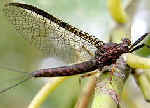 Mayflies - Mayflies are a group of quite uncommon insects. We did not found many of them in Brisbane. They are considered to be one of the most primitive insect order. They have large forewing and small to absent hind wings. They have large eyes and very short antenna. They can be distinguished by their three long abdominal appendages. Their larvae live in fresh water. Adults usually live only a few hours, or some species maximum one day or two.
- Order Odonata
-
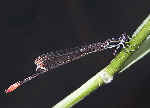 Damselflies - Damselflies are usually smaller than Dragonflies and with slender body. They spend more time to rest and not flying in air than the dragonflies. When they are at rest, damselflies usually fold up and hold their wings vertically. Damselflies lay their eggs in flash water where the larva grow. Larvae need fairly precise habitat and sensitive to water pollution. Adult is a predator in the sky and preying on flying insects. Larva may spend one to three years in water, depend on species, while adults live only a few weeks.
- Brisbane Damselflies Field Guide
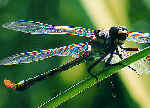 Dragonflies - Dragonfly bodies are long and slender, usually with bright metallic colour. All of them have two pairs of membranous wings. Their hind wings and forewings are more or less similar size and shape. When they are at rest, dragonflies held out theirs wings horizontally. Dragonflies are strong flyer and spend most of the time in air. Their larvae live in fresh water. They have very small antennae but very large compound eyes. Their mouths are very good at biting.
- Brisbane Dragonflies Field Guide
- Order Blattodea
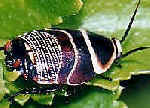 Cockroaches - Not all cockroaches are ugly. Most of them are beautiful insects although this perception is always outweighed by their name "cockroaches". Most cockroaches have long legs, and with antennae longer than the body. Their body is usually flat and broad. Adults may have or no wings. If they have, the wings are membranous with toughened forewings which overlap left over right. The head is small and pointing downwards, concealed under the pronotum. So sometime their thorax are miss-considered as their big heads.
- Order Isoptera
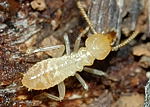 Termites - Termite is very closely related to Cockroaches. They are soft-bodied and live in enclosed environments. All termites are fully social. They live in family group as a colony. Each colony has several castes, with different body shape and behaviour to perform different jobs. Usually there are three major castes, the reproductives kings and queens, soldiers and workers. Nymph stages of all those castes are also present in the colony.
- Order Mantodea
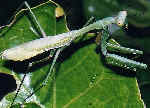 Praying Mantids - Mantids are predators to other insects, with strong forelegs which have spines. They have strong mouthparts for chewing. Their eyes are large and well apart on each side of their mobile head, so that they can locate precisely their prey at close distance. Most mantids sit and wait among the vegetation ready to grasp unsuspecting prey by their powerful forelegs. They wait motionless with their forelegs together and this gave them their name of Praying Mantids.
- Order Orthoptera
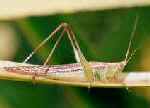 Crickets and Katydids - Their hind legs are highly developed, much stronger and larger than the other four legs. They are very good in jumping. The adults insects have four wings, the front wings, knows as tegmina, is tough and narrow when compare with the hind wings. Crickets and Katydids have very long antennae, some may be several times of their body length. The auditory organs located on the fore legs. Their stridulation are produced by the mechanisms on the base of their forewings. The females usually have long ovipositors extended from the end of their abdomen.
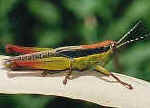 Grasshoppers - Grasshoppers hind legs are highly developed, much stronger and larger than the front four legs. They are very good in jumping. The adults insects have four wings, the front wings, knows as tegmina, is tough and narrow when compare with the hind wings. Grasshopper's antennae are not very long. Most species feed on grass and low bushes. The auditory organs are on the first segment of their abdomen. They produce their love song, the stridulation, by lateral part of their forewings. Females normally larger than males and with short ovipositors.
- Brisbane Grasshoppers Field Guide
- Order Hymenoptera
 Sawflies - Sawflies are closely related to wasps. Females have their special egg-laying tool, like a saw, to cut through leaf tissue for their eggs. Sawflies do not sting. However, the larvae may secrete irritating liquid onto the skin or eyes if disturbed. Sawfly larvae are sometimes seen on trees and shrubs, more commonly seen than their adults. Sawfly larvae are vegetarians and feed on leaf. Sawfly parents do not provide parental care to their young, except they lay them on the suitable food plants and some species guard their eggs until they hatch.
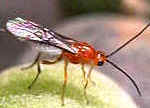 Parasite Wasps - Their larvae are either parasitic or predators. Most caterpillar are targeted host. Some species attacked other insects and spiders. The female wasp usually locates the food plants of the host then searches with her antennae for a suitable host. The female usually has the long ovipositor which is used to insert eggs into the host body. Some species lay eggs externally and attack the host from outside. The host will usually survive when the larvae is still living. Until the larvae fully grown, the larvae either pupates inside the dead host or form a cocoon outside.
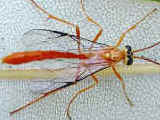 Ichneumon Wasps
- Members in this family have long and thin body, with narrow waist. Adults are active in day time and feed on flowers. Some species are colourful. The female usually has the long ovipositor which is used to insert eggs into the host body. Some species lay eggs externally and attack the host from outside. The host will usually survive when the larvae is still living. Until the larvae fully grown, the larvae either pupates inside the dead host or form a cocoon outside.
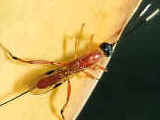 Braconid Wasps
- Members in this family are usually small in size. Their larvae are parasitic. The host will usually survive when the larvae is still living. Until the larvae fully grown, the larvae either pupates inside the dead host or form a cocoon outside. Many aphid parasites are braconid and their life cycles are similar.
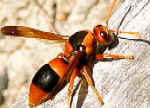 Vespoid Wasps - Wasps have two pair of membranous wings with the forewings lager than the hind wings. The female insects have strings to inject venom to their enemy where the string is their modified ovipositor. Most of them have a waist that separates the thorax and abdomen. Some of the them are social insects. They live in a highly organized group. Wasp larvae are carnivorous. They feed on other insects and spiders. The adult female provide food for them by capturing prey or by laying the egg on or near the food source. Female wasps spend most of their time in finding food and making nest for their young.
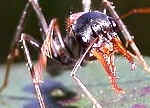 Ants - All ants are in family Formicidae and all of them have a waist. Their waist is composed of one or two knobs which are the first one or two segments of their abdomen. Their antennae have a distinct elbow. Ants live in colonies made up of several castes. These included the winged male, winged female and wingless workers. Ant colonies usually contain: an egg-laying queen and many workers together with their brood i.e., eggs, larvae and pupae. Worker ants carry out different jobs including nest construction, foraging, looking after the brood and queen, and nest defense.
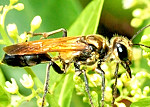 Apoid Wasps - Species in these two families, Sphecidae and Crabronidae, are solitary hunting wasps. Female wasp makes nest in soil or build mud cells for her young. She paralyses host arthropod, usually other insects or spiders, by her sting. The sting is a modified ovipositor which injects venom paralyses but not kill the host. She keep the hosts in the nest and lay egg on hosts body. Larva hatches and feeds externally on prey. Larvae are legless and grub-like.
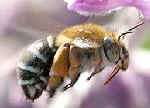 Bees - Most bees live as individual, although the famous Honey Bees are social insects. The solitary bees live in burrow under ground or in tree stems. In their nests, there are chambers for their larvae, beside there are the storage for the nectar and pollen. Some species bees live together and using the same entry, although each have their own nest and look after their own young. Bees' mouthparts are modified to a hairy tongue, which is used for sucking up nectar from flowers. When rest bees fold their tongue in mouth in Z-shape.
- Class Arachnida, Order Araneida
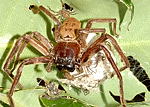 Hunting Spiders - Spider once spelt 'spinder' which simply means 'spinner'. All spiders has their silk glands at their bottom of their abdomen, the back side of their body. Some spiders build webs and some do not. But all spiders make silk egg sac to protect their young. We grouped all the spiders that do not build web in this section.
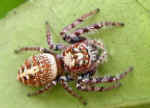 Jumping Spiders - Jumping Spider, the salticids, is a very large spider family. They are from small to medium size. They are easily recognized by their eyes pattern. Their front pair of eyes are very large with another three pair of smaller eyes on thorax, in three row of 4-2-2. They have very good eyesight and active during the day. The arrangements of four pairs of eyes makes their vision covers virtually entire 360 degree.
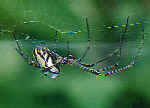 Web Building Spiders - Spider once spelt 'spinder' which simply means 'spinner'. All spiders has their silk glands at their bottom of their abdomen, the back side of their body. Some spiders build webs and some do not. But all spiders make silk egg sac to protect their young. We grouped all the spiders that build web in this section, including those build orb web, tangle web and web casters.
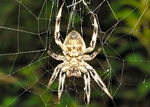 Orb Web Weavers - Araneidae is a large family. They can be small to large in side. All species in this family, if they make webs, they make vertical or horizontal orb webs. Some species construct some sort of stabilizer in the center of the web. Some members in this family do not make web at all. All of them have eight eyes.
