
Uni5 Holistic intelligence
Good Bang to man by David Christian
http://www.youtube.com/watch?v=yqc9zX04DXs
Extremeley good review of life
http://universe-review.ca/F11-monocell.htm#prebiotic
excellent video of origin of cell and moon from Earth
http://exploringorigins.org/timeline.html
Rational thinking of Evolution.
http://www.slic2.wsu.edu:82/hurlbert/micro101/pages/Chap6.html
Timeline of all (more Human) evolution
http://en.wikipedia.org/wiki/Timeline_of_human_evolution
Bacteria in hot springs
http://www.youtube.com/watch?v=HUBZllRV_m0
sound giving patterns
http://www.youtube.com/watch?v=05Io6lop3mk&feature=rellist&playnext=1&list=PL35ACE49E16DAC887
Origin of species evolutionary tree
As buds give rise by growth to fresh buds, and these, if vigorous, branch out and overtop on all sides many a feebler branch, so by generation I believe it has been with the great Tree of Life, which fills with its dead and broken branches the crust of the earth, and covers the surface with its ever-branching and beautiful ramifications.

Understanding evolutionary tress
Excellenet animation of prokaryotic to eukaryotic cells
GOOD still CLIPs OF EMBRYO GROWTH
http://www.ehd.org/prenatal-images.php?thum_id=39#content
GOOD video CLIPs OF EMBRYO GROWTH
http://www.ehd.org/resources_bpd_illustrated.php
about DNA
http://www.ehd.org/movies.php?mov_id=2
http://tfscientist.hubpages.com/hub/explaining-dna-to-a-six-year-old
http://learn.genetics.utah.edu/content/molecules/dna/
excellent stages and detailed embryo growth
http://www.ehd.org/virtual-human-embryo/
Stages of organs growth in embryo
https://www.ehd.org/science_main.php?level=i
Good PPT on Earth - Evolution Ice age, Minerals, etc
http://www.earth4567.com/junior_talks/j-ice.html
Embrology tree
http://www.grin.com/object/external_document.243808/c67a4e314be38b9bf68a87434f6924ea_LARGE.png
stages of human embryo
http://www.youtube.com/watch?v=Mos05fREy7E
Evolution- time line
http://andabien.com/html/evolution-data.php
Evolution good one
http://www.youtube.com/watch?v=f1734g9WN6w
http://www.thegreatstory.org/timeline.html
chart
http://animals.about.com/library/timeline/timeline.pdf
http://www.usefulcharts.com/science/human-evolution-timeline.html
tree of life
http://library.thinkquest.org/19012/treeolif.htm
Simple evolution tree chart-excellent
five systems (good one)
http://textbookofbacteriology.net/themicrobialworld/origins.html
virus evolution
http://www.mcb.uct.ac.za/tutorial/virorig.html
about biology good one
http://www.biologycorner.com/bio1/index.html
interactive animation of animal and plant cell
http://www.cellsalive.com/cells/cell_model.htm
Good animation of cell division phases
http://www.cellsalive.com/cell_cycle.htm
cells gallery
http://www.cellsalive.com/gallery.htm
HUman Genome project
http://www.ornl.gov/sci/techresources/Human_Genome/project/info.shtml
http://www.sciencelearn.org.nz/Contexts/Food-Function-and-Structure
full botony to be colored -material
Human animation of body of cells analogy
http://www.phys.unsw.edu.au/biosnippets/biosnippets_container2.swf
Physics Laws
Beautiful Demo of PV=nRT (Boyles and charles laws and Gussacs

(PV)/T = nR = constant
- when, (PV/T) is a constant, we can compare a system before and after the changes in P, V and/or T:

One mole of an ideal gas, at one degree kelvin and under one atmosphere of pressure will take up one liter. The constant is just an empirical value that connects all those units.
https://www.youtube.com/watch?v=ZvrJgGhnmJo
Force = mass * acceleration
pressure = force / area
density = mass/ volume
volume is
Equal volumes of four different gases at the same temperature and pressure contain the same number of gaseous particles. Because the molar mass of each gas is different, the mass of each gas sample is different even though all contain 1 mol of gas.
PV=nRT
Volume increases with increasing temperature or amount (moles) but decreases with increasing pressure.
25 x 4 = 20x1x5
50 x 2 = 20x1x5
100 x 1 = 20x1x5
volume and temperature
Nitrogen and oxygen have strong inter molecular forces
https://www.youtube.com/watch?v=4d0FA8yImt0
Intermolecular forces exist between nitrogen and nitrogen, oxygen and oxygen, and oxygen and nitrogen. Intermolecular forces also exist between helium and helium. Basically, any two distinct molecules will experience forces of attraction (and repulsion) between each other. The condensation point of a gas is indicative of the strength of intermolecular forces between the molecules in a gas: The lower you must bring the temperature to condense a gas, the weaker the intermolecular forces between the molecules in the gas. The condensation point of helium is 4K (-273 degrees Celsius), the condensation point of nitrogen is 77K (-196 C), the condensation point of oxygen is 90K (-183C), and the condensation point of air is 80K (-194C). In this experiment, what makes the air behave non-ideally is the fact that it is brought below its condensation point. When this is done, the air becomes a liquid! Naturally, then, it won't behave as a gas in this circumstance. Thus, any gas brought close to or below its condensation point will behave non-ideally.
Zero degrees Celsius is now defined as 273.15K. As one degree Celsius is equal to one Kelvin, boiling point of water is equal to 273.15 + 100 = 373.15 Kelvin.
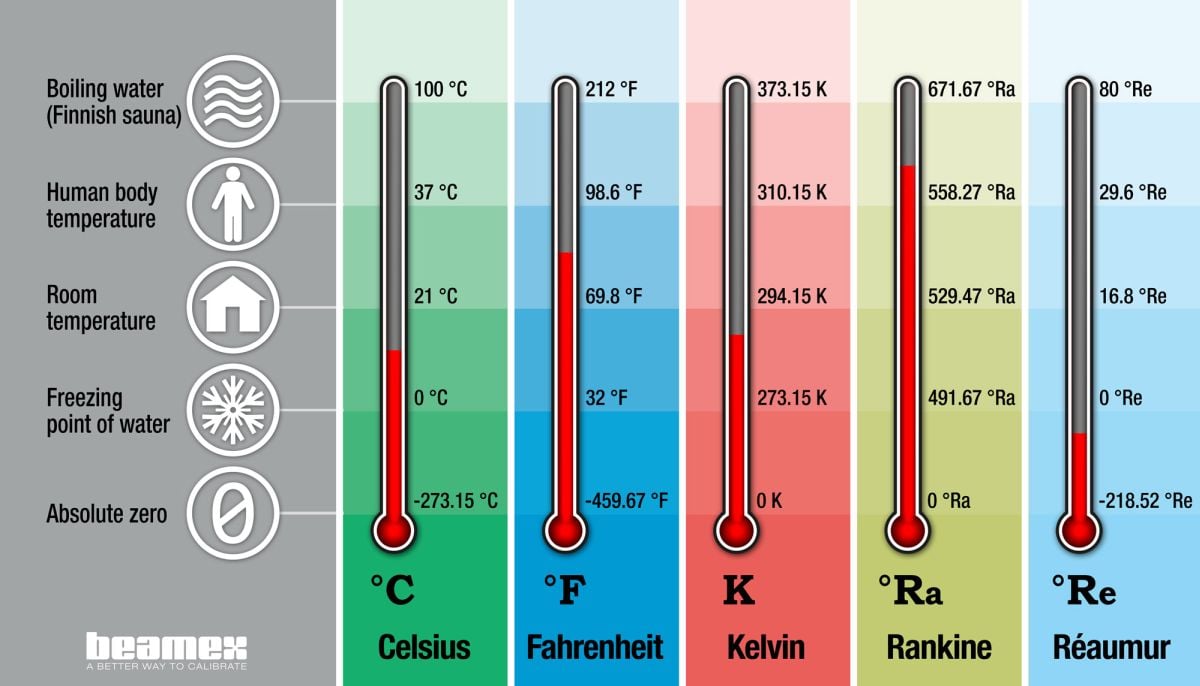
Kinetic Molecular Theory and the Ideal Gas Laws
https://www.youtube.com/watch?v=robEY-idcLU
-
- The force of gravity, g = 9.8 m/s2
Gravity accelerates you at 9.8 meters per second per second. After one second, you're falling 9.8 m/s. After two seconds, you're falling 19.6 m/s, and so on.
- The force of gravity, g = 9.8 m/s2


