
Uni5 Self Awareness
- Details
- Parent Category: Vedic Questions
- Category: Rituals Questions
- Hits: 4914
a
- Details
- Parent Category: Vedic Questions
- Category: Rituals Questions
- Hits: 5661
Right : Why use right hand?
Right handedness.
Usually in Indian culture we pay attention to use right hand while giving and receiving anything from others.
Human evolved from lower animals when started using hands. It is the usage of hands that speeded up the evolution by stimulating the growth of brain. Hands and brain are so interconnected. children should be allowed to use hands a lot while growing up to be smart.
The Human brain is divided into two parts the Right Brain and Left Brain. The left side of our body is "wired" to the right side of our brain, and vice versa. For whatever reason nature did this cross-over, it applies even to our eyes, which process a majority of their sensory data on opposite sides of the brain.
ustrate the characteristics which are known to reside on each side of our brains.
|
LEFT BRAIN FUNCTIONS uses logic detail oriented facts rule words and language present and past math and science can comprehend knowing acknowledges order/pattern perception knows object name reality based forms strategies practical safe |
RIGHT BRAIN FUNCTIONS |
Courtesy of Dan Eden web site.
The right hand usage stimulates more neuronal activity in the left brain and left hand stimulates more neuronal activity in the right brain. The reason is that all our action should be done with logics. However, when doing all rituals the hand right along with left hand is used denoting the co-ordination of the two hands. Actions done with no emotional involvement will not be complete and be boring. Doing actions with no logic but out of excitement do not give the desired results and often results in more suffering. Bottom line is that the logical reasoning (analysis) along with the emotional involvement alone brings success in all our actions.
Why do we hold ear lobes and squat down to the ground before Ganesha?
When we did mischief , especially at school, the Indian teachers gave a small punishment. This is in Tamil is called "Thoppu Karanam". Now Brain studies shows this punishing act infact improves brain function for both young and adults.
See this video demonstration of how the EEG patterns change when some one does this Ganesha Ritual.
http://www.youtube.com/watch?v=KSwhpF9iJSs is the link for super brain yoga
- Details
- Parent Category: Vedic Questions
- Category: Rituals Questions
- Hits: 9926
Water Ritual
busy to remember this fact, Vedic tradition takes a brief moment during cleansing the external body (Shower), when the body and mind become fresh.
 This is a simple ritual which gives us freshness and positive thoughts in our mind when done every day. It takes 10 to 15 seconds in the bathroom.
Every day in shower take a handful of water or water in a bowl and turn towards East direction and offer your honors (Prayer) to the river. Why river?. because without water there is no life. Rivers are the source of drinkable water (though Ocean is abundant with water. Why turn east?.
Because Sun rises in the East and it is the Sun that does distillation (purification) of Salty Ocean water to clouds and then Rains to the river.
It is good to pray to all the Holy Indian rivers like Ganga, Yamuna, Cauvery etc and also add the country's river you are living also as a mark of honor. If you are in the USA then add to it Missouri and Mississippi too and so the river based on the country you are living.
You can even chant mantra
Gangacha Yamunecheva. Godavari Saraswathi. Narmadha Sindhu Kaveri, Jalasmin Sannidhim Kuru.
This acknowledges the importance of rivers as the source of our life.
Then towards your right side, and the direction will be South, the direction of Pitrus (Ancestors). Then offer one-third of the water you hold as offerings to all your ancestors. You can also chant "Arpanam" , which means your offering. Krishna in Sanskrit means black, here it means the Energy that is not visible or dark, which is the subtlest Energy. So chant "Krishnar-panam", meaning I offer to the subtlest invisible or unperceivable Energy, which is the "only one source" of all beings living or non-living. To that Single Energy source we connect with this offering.
Take a turn to your right side, then the direction will be west , the direction of the Guru. After your ancestors, you are honoring your Aadhi-guru (First guru) your parents. Think of them. Then next to your Sat-guru (Guru who gives the Knowledge) and your Acharya (one who teaches rituals). Pour next one-third of the water with the chanting " Arpanam or Krishnar-panam".
Then turn to your right, it becomes North, the direction of none and there is nothing to offer.
Take again a right turn and you face east, the direction of Devatas. Pray to the three energies "creation, sustenance and destruction, the Trimurthy Devas (Brahma, Vishnu and Shiva) and Tri-Devis (Saraswathy, Lakshmi and Parvathi), the Pancha Bhutas (Five elements) , Navagrahas
(Nine Planets) and all the Gods and Goddesses and the local gods also and offer the final water with "Arpanam or Krishnar-panam".
Every day doing this ritual during bath takes only less than 20 seconds but make your day and life very complete, because you are acknowledging and honoring all the forces for your existence.
You clean the body with water and do this ritual at the end of the bath. After this ritual, you take the final shower.
Taking bath with a bowl reduces the wastage of water and time. Taking bath with shower, we waste lots of water because we start to think of all worldly matters and just stand under the flowing water. By using a vessel and bowl to take bath, you are aware of the bath and time and reduce wastage of water, time and energy and also you get the belly exercise of bending down to get water.
- Details
- Parent Category: Vedic Questions
- Category: Rituals Questions
- Hits: 9208
Water Prasad
In water therapy page you would have read about the importance of water, especially its ability to get the subtle vibrations.
Chanting and Water in Ancient practices
Like other traditional cultures, ancient Indian scriptures considered water a sacred element and it formed the most essential part of all rituals. It was a strict practice to keep water in a vessel at the place where the rituals were being performed, especially when chanting holy scriptures. It is considered a sin to do any rituals without water even if one does not offer flowers, fruit or any other food to God. After the rituals, the water is usually given as 'prasad' in temples and homes.
In Indian temples after the priest does the chanting he distributes water which carries the sound vibrations of the chanting. There is a great secret behind this practice. The sounds produced during chanting of holy scriptures have great influence on the health of the people listening to it. The healing effect of sounds is scientifically proven and need not be described here. Water has a remarkable property of absorbing subtle sound vibrations. Drinking this water after chanting will be doubly beneficial because the sound vibrations will reach each and every part of the cells in the body through water.
The sacred syllable "AUM" was written on a glass of water and the crystal structure that was observed is shown below:
Water crystal obtained by labeling with the Vedic sound Aum
Flavors, Aroma & Water
Dr. Masaru Emoto treated water with aromatic oils and was surprised to observe the water crystals which were similar to the look of the flowers that the aroma oils were made from
This explains again why in Indian temples, herbs were added to the water before chanting of Vedic scriptures. The most common herbs used include bilva, basil, camphor, neem, turmeric, darba grass etc. This herbal water is usually given to the devotees after worship.
Bathing Rituals in Spiritual and/or Religious Traditions:
One of our friends conveyed a message that water was the only chemical substance among thousands of chemicals tested by scientist that could detect the subtle vibrations that reach the earth from stars and planets thousands of miles away. This also proves that ancient people understood the mysterious powers of water and inculcated the practice of bathing in rivers on specific days when the water receives vibrations from other planets and galaxies.
https://www.youtube.com/watch?v=o0gBoV0ygJc
- Details
- Parent Category: Vedic Questions
- Category: Rituals Questions
- Hits: 9361
Tilak
Tilak is a mark on the forehead applied to remind us and others the seat of Intellect. In this web page, you have several read times that it the intellect that draws us closer to awareness. Tilak is applied at the Ajna Chakra, the space between the two eyebrows to  indicate the third eye. Third eye is the spiritual vision, through which you understand that you are that immortal soul (atman) and not the mortal body.
You would have read the symbolism of Snake on Shiva's neck. The snake has eyes which are small and is invisible. The big visible eyes are not real, they are just to camouflage the predators. Similarly our two eyes are not real, which means that they project the world unrealistically. For example, the Sun is not rotating over the Earth but our eyes project as though sun comes up every morning and moves towards west. Similarly things are not really colored, they are just absorption of light at different spectrum.
The physical eyes thus camouflage the reality which is Brahman, the Consciousness. Our real eyes of vision are the witnessing eyes of Awareness. The awareness is the reality but we miss the reality by the false projected world. This is the third eye of Lord Shiva, which is the Eyes of Awareness, which destroys unreality. This is to remind both the user and others to understand the reality of this world.
You should remember this third eye every time you apply a Tilak.
Applying Tilak in the morning is to remind us the whole day that we have to be aware of our Self. The very touch on the area between the eye brows brings the awareness. Touching the area before meditation helps the wandering mind to stay as a feeling connected to the area of the body. When cool sandal wood paste is applied before meditation, it facilitates the attention stay on that area and avoid the mind going away from the body thought.
Purpose of life and spiritual practice is to realize Self. This is achieved by reflection and contemplation in prayer room. But we have to leave the prayer room for our routine worldly duties. So when we leave the prayer room, the tilak in forehead is a remembrance that all our actions in the world is dedicated to the Self. Fore head is the seat of memory. The mark on the head also reminds other person whom we meet to remind of his purpose of tilak, which is to understand that all our activities are oriented to the realization of the Self.
The fingers used for applying Tilak are as follows:
 The ring finger is the finger representing mind and so when one applies tilak to another person the ring finger is used to denote emotion. The base of the ring finger is the mount of sun and so it represent light. Thumb is the finger representing Brahman and so it is also used to apply tilak to denote god’s grace. Since marriage is the emotional binding of two individuals , the groom applies the tilak to the bride with his ring finger, the finger representing mind.
Three major colors of tilak
These are the yellow white and red Viz, sandal wood paste, ash of cow-dung or kumkum (tumeric mixed with lime stone).
 The white ash (Bhasma) is applied on the forehead to remind us that everything that gets created in time and space finally goes into a formless state (awareness) indicating mortality of our body.
The sandalwood paste (Chandan) is applied to indicate the sweet fragrance of the Self in the form of intellect in us.
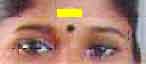 The Kumkum, a red tumeric powder to denote the energy manifestation of Consciousness in this universe. According to Vedic Astrology, Mesh Rasi or the House of Aries is on the forehead. The Lord of Mesh is Mars and His colour is Red. This is why Red Chandan and Sindoor is placed as Tilak on the forehead.
Tilak is sometimes applied as three horizontal or vertical lines indicating the three Gunas, Sattwa, Rajas and Tamas and also the body, mind and intellect that we have to transcend in order to realize our True self.
Subcategories
SAL Energy
Rituals and SAL Energy
Rituals in Sanathana Dharma
Festivals in Sanathana Dharma
Rituals in other Traditions
Festivals in other Traditions
CAC
CCC/CAC/Literature
Vedic Literature - English
We have organized this section in the Uni5 pattern
Body-Rituals and Festivals- About symbolism of rituals, festivals
Mind- Slokas-Music-About slokas, sthothras and music ragas
Intelligence-Gods-Scriptures-about the literature of gods.
Awareness-Temples / Pilgrimage- About temples, pilgrimages
Consciousness-Devotees-About the life history of all different devotees, including patriots
Vedic Literature - Tamil
We have organized this section in the Uni5 pattern
Body-Rituals and Festivals- About symbolism of rituals, festivals
Mind- Slokas-Music-About slokas, sthothras and music ragas
Intelligence-Gods-Scriptures-about the literature of gods.
Awareness-Temples / Pilgrimage- About temples, pilgrimages
Consciousness-Devotees-About the life history of all different devotees, including patriots
Vedas Sakthi
Festivals
Pilgrimages
Yathra
Yatra
