
Vedas Sakthi
- Details
- Parent Category: Vedas Sakthi
- Category: Vedic Symbolsim
- Hits: 15244
Creation in Puranas
Why is Lotus shown in Creation?
Lotus is a flower that blooms in presence of Sun and shrinks when Sun sets in the west. The same way, creation (Lotus) blooms in presence of Consciousness (Sun). If Consciousness can be symbolized as Sun, then Awareness is the Sunlight. All the forms including Human beings have Consciousness and Awareness. But when the body dies, it is the Awareness is what is lost.
When the Consciousness that reflects as awareness is gone, it is a "life-less or in-animate" object. The loss of Awareness  which is called death. Presence of Awareness is life. The lotus blossoms everyday in presence of sunlight and shrinks in the absence of sunlight. This constant blossoming and shrinking of Lotus flower is the symbolism of birth and rebirth.
The whole creation starts from Vishnu and the lotus springs out from his navel and on that sits Brahma the Lord of Creation. Brahma has four heads, the three axes of directions and space. The Brahma is the mind the creator. Lotus is the body and a plant like Lotus is used because plants are the food producers for the other organisms, since they can only capture sunlight. Like the umbilical cord connecting the womb and mother's body so does Vishnu the Cosmic Intelligence connects to the mind of us.
Without Consciousness there is no creation and so does without Vishnu there is no "jagat" or World. But this Vishnu holds a shiva-linga which means that the Consciousness expresses itself through Awareness the Shiva. This is why Vishnu holds the shiva-linga.
 The blue cosmic ocean is the unlimited space and the Ananta, the snake is the eternal time. On this eternal time and space blooms this whole creation. It is fascinating know the mystery of creation when we understand each of the symbolism in the vedic puranas. We will explain more in the forth coming sections.
This is the (old) symbol of Sakthi Foundation. Aum is the Symbol of Consciousness (Sun) for the creation of knowledge.
This is the meaning of chin-mudra. Little finger represents body, ring finger represents mind (that is why in wedding ring is worn in ring finger or mind finger because the event is the joining of two individuals are mind level) . The middle finger is the senses and the 
fore finger is the “I” or ego thought. The thumb is the consciousness finger or intellect finger without which the other fingers are useless. The forefinger is always found associated with the other three fingers and when it transcends them it merges with the thumb to form a circle which indicates that this consciousness has no beginning and end.
- Details
- Parent Category: Vedas Sakthi
- Category: Vedic Symbolsim
- Hits: 13087
Puranas & Vedic Literature
The Vedic literature is the book of life. It gives all these information in a well structured manner. Spiritual masters in every age help mankind to understand the purpose of life and through that they help mankind in progressing through their evolutionary journey. The master's life become guiding lights in the darkness of our ignorance.
Since it is very difficult to understand the purpose of life , all the vedic information is given in a symbolic form. Exactly like the first school book is in the form of symbols, so is vedic literature. A student learns alphabet through symbols. "A" for apple, "B" for ball, "C" for cat etc. The knowledge is given in the form of symbols.
Indra - chief of the Devas (Gods)
Since the human mind is always revolved around the world of senses (Indriyas), God Indra is talked and praised first. His kingdom of heaven (Swarga) is talked about. The rituals of obtaining wealth and prosperity etc is later given. Then comes the element of sacrifice which most of them wrongly interpret it as sacrifice of animals. Since we have evolved from animals, we still carry the trace desires of it. We have to sacrifice those animal nature and evolve to pure man. Unfortunately this information is taken as literally and animal sacrifice was performed.
 Kali drinking blood after chopping the demon mahishan's head and drinking his blood, thank God, is not literally followed. Otherwise we would be cannibals drinking human blood. Here the buffalo head Mahishan represent Ego. Buffalo is a
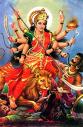 black colored animal that is lazy and swims in dirty stagnant water. Lack represent darkness or total absorption of color which symbolizes the attitude of Ego. Ego is totally absorbed only in its welfare and not concerned of anything. Ego like buffalo is lazy and dwells in the stagnant darkness of ignorance.
Blood represents energy and so Kali drinking blood indicates that we have to chop off of our Ego and drink the energy of the Ego which means directing that energy in our Journey to the Source. This is how the whole of Vedic literature including the puranas are wrongly mis-understood.
In the next few pages we would try to give the best interpretation of the puranas and Vedic literature.
The best part of this Vedic-Science is that it can be experienced by us. This knowledge that we can experience is known as "Vidya" and the knowledge of the manifested universe that can be experimented is known as "Avidhya". This is why in lalitha Sahasranamam, the Consciousness which is symbolized as Devi is praised as Vidya-Avidya sorupini. It is this Pure consciousness that is both the experienced and experimented.
- Details
- Parent Category: Vedas Sakthi
- Category: Vedic Symbolsim
- Hits: 14639
Eighteen Puranas
The Vedic Mythology
Puranas are Symbolic Language to explain Eternal Truth.
There are 18 puranas compiled by the greatest Genius Sage Vyasa as "Puranas". He used such an brilliant approach of using a real event in history to convey the same message through his historical work, the Mahabharata, the biggest literary work ever composed. The Puranas narrate the history of the various dynasties and hierarchies that emanated from the supreme Consciousness. As a continuation of the lines of Priyavrata and Uttanapada (vide, the doctrine of creation under the Upanishads, above), the world saw the coming in of many heroes, both spiritual and temporal. These offspring of the ancient ones included both the divine and demoniacal natures, which waged a perpetual war between themselves, and much of the Purana content is devoted to descriptions of these conflicts between the Devas and Asuras.
Other than these earlier descendants of the progenitors of the race of all beings, particular mention must be made of the lines of the solar and lunar races of kings and sages, whose lives provide a highly interesting biographical reading of both human and superhuman natures. The history of these dynasties is brought down almost to our own times, thus connecting our present-day existence with the diviner sources from which we have come, as, in the words of the Upanishad, children of the Immortal (Amritasya Putra).
But through these historical events and life of great men, Puranas helps us to understand what is Consciousness, the Mystery of every Human being, whether he or she was in the ancient age or living in this modern age. It is the birth right of every human being to understand the Mystery of Consciousness. The Rishis says the very purpose of Human's life is to realize this Consciousness.
Only with this clear understanding of Body-Sense complex, Mind, Intellect and Awareness can the Puranas be understood without any misgivings. With this simple understanding one clearly understands the Symbolism of all Vedic Gods, rituals, culture and the Purushartha (goal) of Mankind.
Most of the Puranas abound in lengthy narratives of legends glorifying a particular god or deity, delineating his or her incarnations, descriptions of holy places of pilgrimage (Tirtha), vows or observances (Vrata), acts of charity (Dana), and the like, with some shorter or longer references to the process of creation, the genealogy of the gods, demons and kings, stories of Rishis, as well as occasional statements on the foundations of politics, and the arrangement of the continents of the world as parts of the cosmos.
Thus, the Puranas form a general encyclopaedia of popular thought on religion and philosophy. But the Bhagavata and the Vishnu Puranas are a great exception to this rule and they constitute a really splendid literature on a very lofty philosophy and mysticism.
In Vedic tradition, however everything is centered around the main Trinity Gods Brahma, Vishnu and Shiva are the symbolism of the Mind, Intellect and Awareness. Brahma is the creator God, Vishnu the sustainer and Shiva the destroyer. All the three originate from the Supreme Para-Brahmam, the Pure-unconditional Consciousness.
Web sites that give information on the meaning of Puranas,
Another site giving information on the meaning of 18-Puranas,

- Details
- Parent Category: Vedas Sakthi
- Category: Vedic Symbolsim
- Hits: 33268
Symbolism In Vedas
The incomprehensible made Simple to understand :
We have discussed earlier that Rishi's having well researched on the sense organs, thoughts, Mind and intellect, stood spellbound at the immense potentialities in the field of Awareness. Among those very few Rishi's were able to swim from the river of Awareness into the Ocean of Consciousness. This is Self Realization or Enlightenment.
If thoughts are water droplets, then Mind is a Spring-water, and intellect is the flowing stream joining a mighty river of Awareness, which finally merges into the Ocean Of Consciousness.
The Rishi's called this Ocean of Consciousness as Brahman in Sanskrit. The river of Awareness has a structure to define but how could one articulate about the Ocean of Consciousness? Thus the Rishi's used the language of Symbolism.
When the Rishi's themselves find short of words to describe Consciousness, how could the layman string it into words? It is like a deep sea diver describing Ocean to a villager who had never seen more than well-water. He could show a bottle of sea water to the villager and if the villager was an Egoistic person not believing in the Existence of Ocean, would spit out the salty water of the Ocean water branding it as "tasteless-brine water".
This led the Rishi's to develop Symbolic Images of this Ocean of Consciousness and the river of Awareness to well-water layman. This became the fundamental basis to put their research findings into Vedic literature. It is not a single Rishi who wrote these Vedic texts. Over ages the knowledge had been accrued similar to Modern Scientific Research.
The language style of modern scientists is different from how they convey among their peers than with the layman. Among peers they use technical words ,but for the Public they use pictures and symbols and stories to explain.
Similarly Rishi's abstract findings are technical words which they use to convey among their peers. For layman they used Puranas or Mythology to reach the public. In the next few pages we will see how they beautifully conveyed the message of Consciousness, Awareness, Intellect, Mind, sense organs and many more aspects of the mind of Individuality, Ego, different negative and positive thoughts. All these became human characters. The character's are fictional but what they implied is not fiction, it is real that we experience in every day to day life.
- Details
- Parent Category: Vedas Sakthi
- Category: Vedic Literature
- Hits: 14543
Three Philosophical views
The three levels of body mind and Consciousness are these three levels. The three levels however cannot be understood as supremacy of one over the other. The three are only the ways of evolutionary understanding.
A classical physicist says it is a solid mass under the laws of gravity etc. He considers the stone is different from a human body.
- A quantum physicist says it is quantum pack of energy. He considers both the stone and body are quantum packs of energy, but still there is slight difference.
-
A dvaitic is like the classical physicists who says the paramatman is different from the jiva.
A vishist is like the quantum physicist, who says the paramathan and the jiva are same but slight difference.
A advaitin is one who says there is no difference and the difference is only maya (which means not there but sees only at the gross level and not at the ultimate level).
Adishankara, Sri Ramanuja and Sri Madhavacharya have done independent analysis of the ancient texts and formulated stunning philosophical formulations. Shankars’s ‘Advaita’ which unifies God and Man, Ramanuja’s, “Vishista-Advaita” which makes existence a journey towards unification and Madhacharya’s ‘Dwaita’ which separates the Creator from the created.
Carvaka philosophy
Carvaka (Cārvāka) is a system of Indian philosophy that assumed various forms of philosophical skepticism and religious indifference.[1] It is also known as Lokāyata. It is named after its founder, Cārvāka, author of the Bārhaspatya-sūtras.[2]
In overviews of Indian Philosophy, Carvaka is classified as a "heterodox" (nāstika) system, the same classifcation as is given to Buddhism and Jainism.[3][4] It is characterized as a materialistic and atheistic school of thought. While this branch of Indian philosophy is not considered to be part of the six orthodox schools of Hinduism, it is noteworthy as evidence of a materialistic movement within Hinduism.[5]
It is important to understand the difference between science, religion, atheism and spiritual at this juncture.
| For more details |
Subcategories
Festivals
Pilgrimages
Yathra
Yatra
