

Successful UGC- CSIR GATE Exam Preparation
An Effective Way to Succeed in CSIR — From Personal Experience
During my M.Sc. second year, I appeared for the UGC-CSIR examination for the first time — and cleared it. I was one of the very few in my class to do so on the first attempt. Many of my classmates relied mainly on classroom notes. I chose a different approach.
I went to the library every single day. I studied textbooks completely — from the first page to the last page. Not selectively. Not for exams alone. I read to understand.
Later, while waiting for admission to the USA, uncertainty and fear pushed me to appear for the UGC-CSIR again. I cleared it a second time. I also qualified in AIR Agricultural Sciences.
What made the difference?
I did not study for marks.
I did not study to impress teachers.
I studied for myself.
Deep learning builds confidence. Full-book reading builds conceptual clarity. Self-driven preparation builds resilience.
This mindset should not stop with student life. The same principle applies in professional life:
Master fundamentals.
Study beyond what is required.
Build depth, not shortcuts.
Learn for your own growth — not for validation.
Excellence is rarely accidental. It is usually built quietly, consistently, and independently.
— Pradheep Chhalliyil, Ph.D
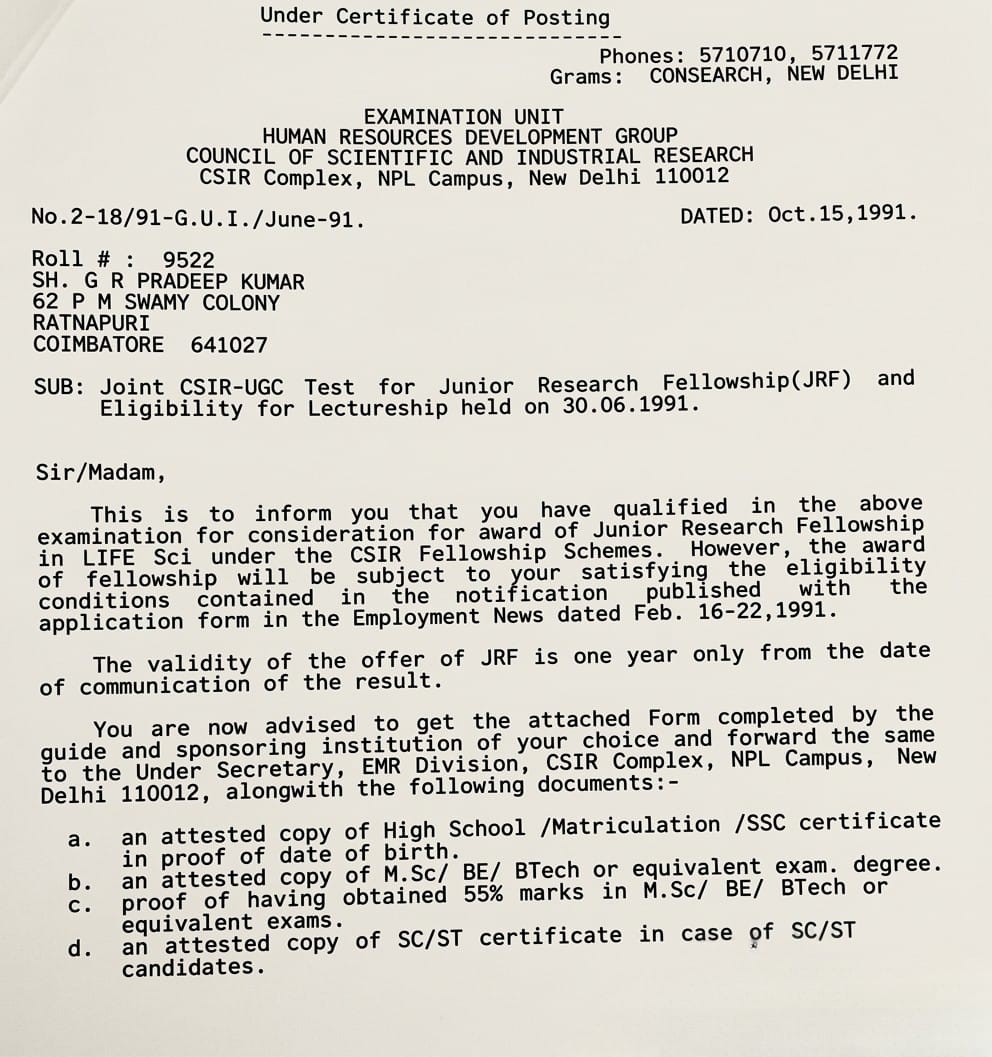
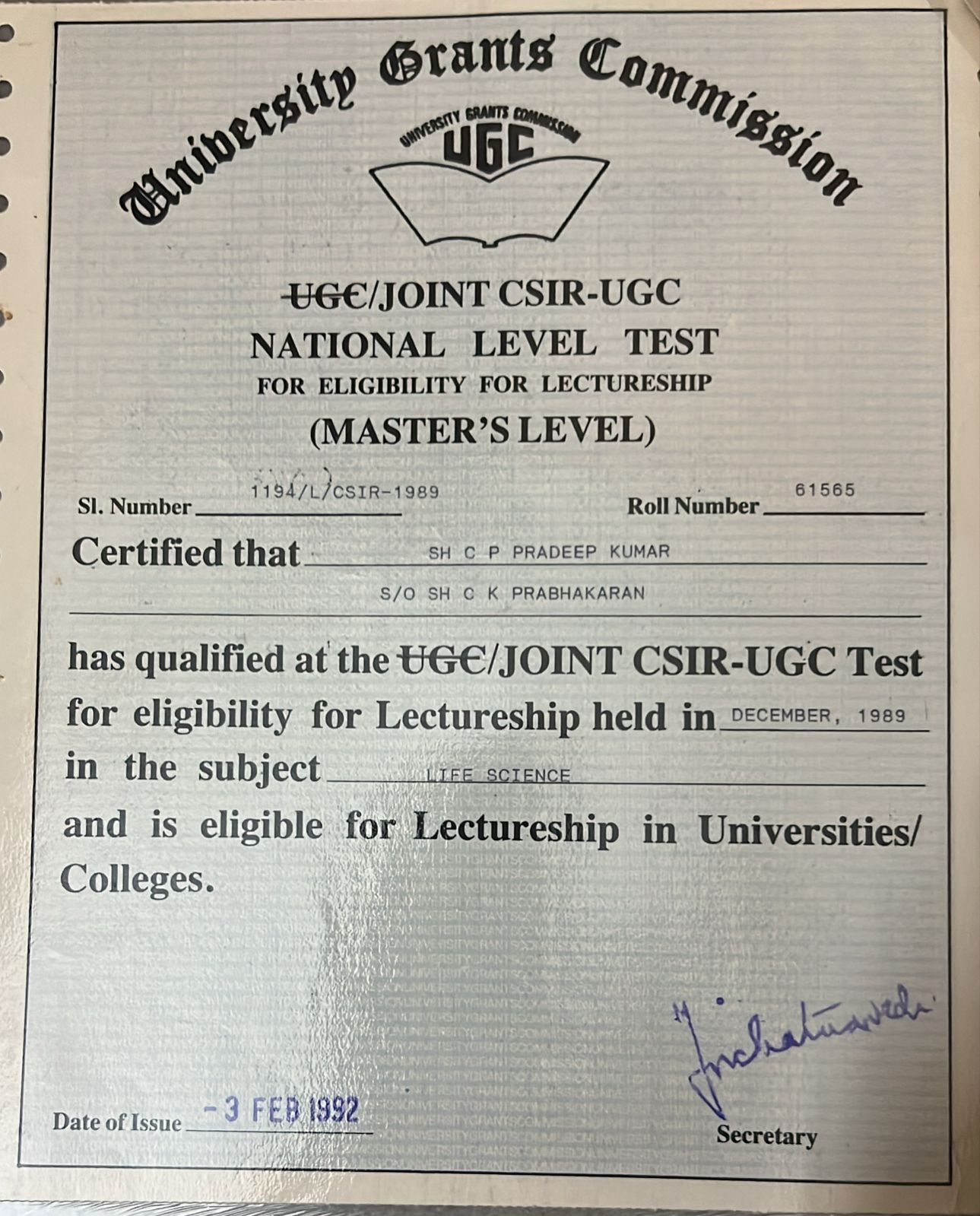
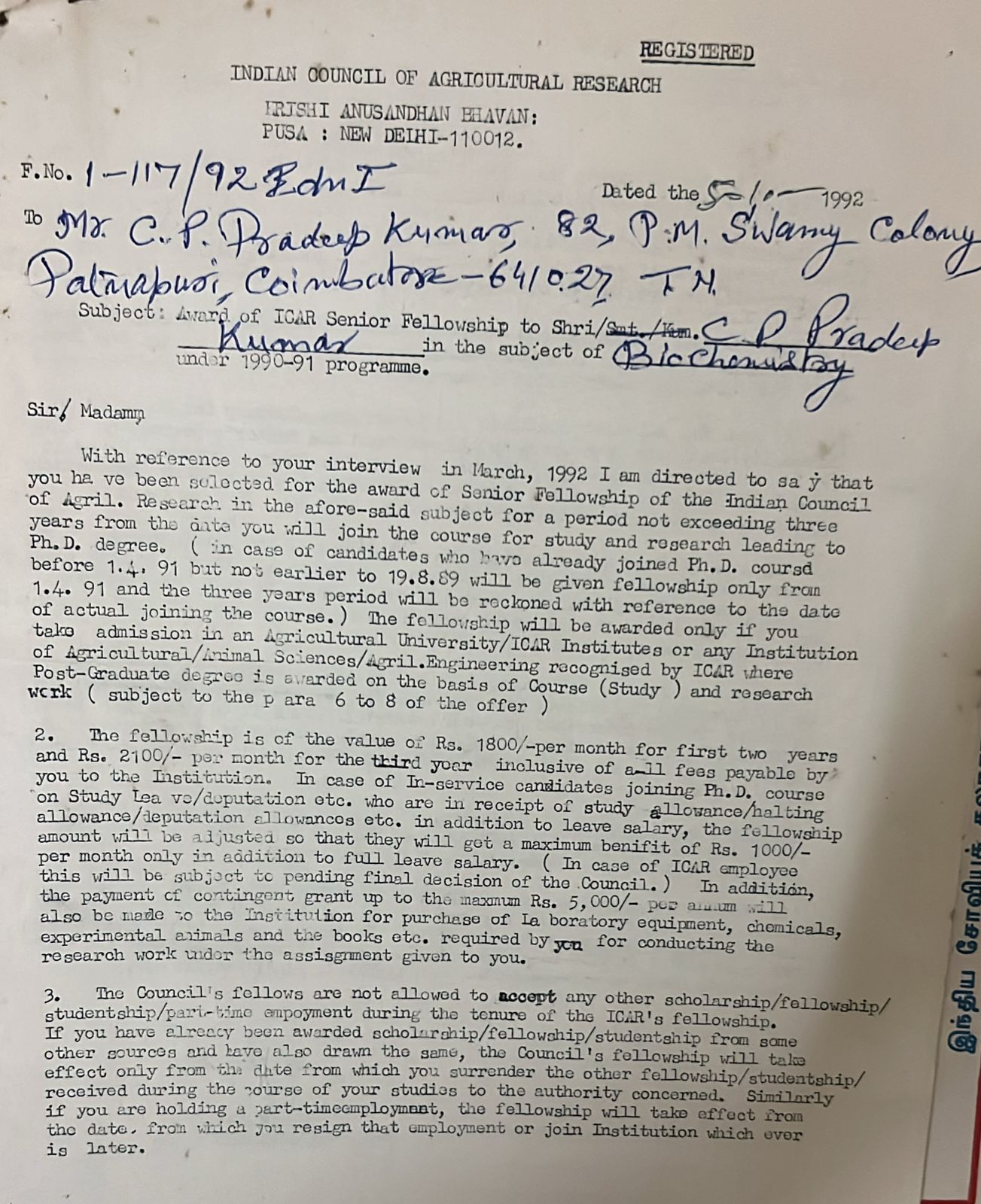
I also cleared ICAR Indian council of Agricultural Research in PUSA Campus interview.
so I got JRF fellowship to agricultural research too
Please find tips for successfully passing CSIR exam and also effective preparation for interviews.
CSIR-UGC NET Exam for science stream is conducted by CSIR twice a year in June and December in the following areas:-
Chemical Sciences, Earth Sciences, Life Sciences, Mathematical Sciences, Physical Sciences, Engineering Sciences
The Single Paper Multiple Choice Question (MCQ) based test shall be for the duration of three hours. The question paper comprises of three Parts.
Part "A" shall be common to all the subjects. The Model Questions may be viewed under heading “General Science”
Model Questions Papers of Part B and C relevant subject may be viewed by clicking on the relevant subject 1. GENERAL SCIENCES -PART A (COMMON) 2. CHEMICAL SCIENCES-PART B & C 3. EARTH SCIENCES -PART B & C 4. LIFE SCIENCES -PART B & C 5. MATHEMATICAL SCIENCES -PART B & C 6. PHYSICAL SCIENCES -PART B & C 7. ENGINEERING SCIENCES -PART B & C
Part A:
Part A preparation is as important as you prepare for other sections. Most of the students fail because they dont prepare much on part A. We strangly recommend to do that.
General Tips:
Do not study for the exams, but for knowledge that makes you an expert in the field. Your teachers do their duty giving notes and some guidance that will help you get a passmark and degree certificate. But that will not help you success in interviews and at work. so study a book in full and not class notes.
Example, if you are a Life science ( Biochemistry, Microbiology, Biotechnology, Environmental science etc) degree student, then you should be thorough in Biochemistry, because that gives the fundamental knowledge to apply in practical world. So instead of reading class notes, one should read Biocheimstry from the first page to the last page with the same interest one reads a novel. One has to take hints. This means, after a read a paragraph or a page, just write the essence of it in one or two lines. Make a note of some numerical facts example, size of a bacterial cell, or the reaction rate of carbonic anhydrase etc. By the time you finish reading the whole book, you should be having a self written hint book of it in less than 10 pages. You have condensed the 1000 pages of the book in less than 10 pages. It will require for you to revise the whole book by reading the 10 pages in less than two hours equal to reading the whole book. This gives you less stress before the exam and also before attending an interview.
Timing of study is very important. If you read the whole Lehinger in one year, then it will take commitment for you to read every single day 3 pages. If you miss reading one day, then the next day yo have to read six pages to cover the book in the stipulated time. Most important is to do problem solving at the end of each chapter, because that will help you later in work to trouble shoot challenges given by your boss at work. Remember at work, there are no books that will give the solutions for the challenges you face. You have to figure out yourself (be creative) to solve the challenges. This will be possible only with the depth of the knowledge you gain in student life reading full book and doing problem solving questions.
For CSIR and future exams. Read the following books in full. Biochemistry - Lehinger One techniques book One gene cloning book.
Some good books are given in the below link about csir syllabus. It is worth to read campbell's Biology book fully and Biochemistry Lehninger to get a good view of the subject. More details in the below link
Effective way to success in CSIR in first attempt.
1.CSIR forms and details. All subjects CSIR syllabus.
Read the general instructions for Students to understand the logic behind success.
THE Uni5 FIVE Levels for Success
1. Physical commitment — Are you willing to work without guaranteed returns, for years, without quitting when nothing seems to work?
2. Emotional resilience — A word of criticism, a failed experiment, a colleague's doubt — can you hold your ground? Sensitivity is beautiful. But fragility is fatal in a research lab.
3. Intellectual hunger — Not just reading papers and reproducing what others did. The urge to make knowledge your own by doing something novel with it. That is the difference between a degree and a discovery.
4. Financial purpose clarity — Does this work lead somewhere real? Have you mapped it honestly? A PhD alone is not a financial plan. Knowing how it connects to something viable is your responsibility — not the system's.
5. Global impact vision — The scholars who survive the hardest years are the ones who hold a larger question: Does this matter beyond me? That question becomes fuel when everything else runs out.
─────────────────────────────────
When I joined the lab, my peers were reading papers and copying methodology. I asked a different question: what can I build here that will matter to someone outside this room? I dropped my ego. I accepted that failure was data. I worked in service of my mentor and the science — not for my degree.
The result was Cleistanthin.
The system must change — absolutely. Better fellowships, transparent recruitment, structured postdocs, research-to-industry bridges. India needs all of it.
But a student who enters without these five qualities will struggle in any system. And a student who enters with them will find a way through even a broken one.
Both truths must be held at the same time.
I used to work on Problem solving books as guided by my professor Dr.Abitha Devi PhD
Ten biology textbooks that have their own separate problem or solutions book
- Molecular Biology of the Cell (Alberts): The Problems Book (Wilson & Hunt)
- Biochemistry (Stryer / Berg): Student Companion (Gumport, Deis & Gerber)
- Fundamentals of Biochemistry (Voet, Voet & Pratt): Student Companion (Uzman et al.)
- Biochemistry (Garrett & Grisham): Student Solutions Manual, Study Guide and Problems Book
- Molecular Cell Biology (Lodish): Solutions Manual
- Campbell Biology (Urry et al.): Study Guide (Martha Taylor)
- Introduction to Genetic Analysis (Griffiths): Solutions MegaManual (Fixsen)
- Concepts of Genetics (Klug): Student Handbook and Solutions Manual
- Genetics: A Conceptual Approach (Pierce): Solutions and Problem-Solving Manual
- Guyton and Hall Textbook of Medical Physiology: Guyton and Hall Physiology Review
- Biochemistry (Lehinger): Student Companion
- Biochemistry and Molecular Techniques
For pure problem-solving practice, the Alberts Problems Book is the strongest of these.


