
Vedas Sakthi
- Details
- Parent Category: Vedas Sakthi
- Category: Rituals
- Hits: 6480
Black Magic Evil Eyes Nazar
Read more details in these links
http://uni5.co/index.php/forum/10-rituals/1428-is-black-magic-evil-spell-curse-real.html
http://uni5.co/index.php/forum/22-astrology/498-camphor-burning.html
- Details
- Parent Category: Vedas Sakthi
- Category: Rituals
- Hits: 8310
agnimile purohitum yajnasya devamritvajam hotaram ratnadhatamam
Agni, the high priest of the sacrifice, the divine, the ministrant, who presents the oblation and is the possessor of great wealth. [Agni = purohita, the one who does thr ritual or, he is one of the sacred fires in which oblations are first (pura) offered (hita); deva: the cause-effect-cosmic force, the bright, shining, radiant; fr. div, to shine; or, one who abides in the sky or heaven (dyusha_na); or, liberal, donor (in the sense of giving); r.tvij = a ministering person, he is also the hota_ (Aitareya Bra_hman.a 3.14), the priest who presents the oblation or who invokes or summons the deities to the ceremony; fr. hu, to sacrifice; or, fr. hve, to call; ratnadha_tama: lit. holder of jewels; ratna = wealth in general; figurately, reward of religious rites].
from http://sankhyakarika.webstarts.com/uploads/Sanskrit.pdf
- Details
- Parent Category: Vedas Sakthi
- Category: Rituals
- Hits: 9789
Caste System
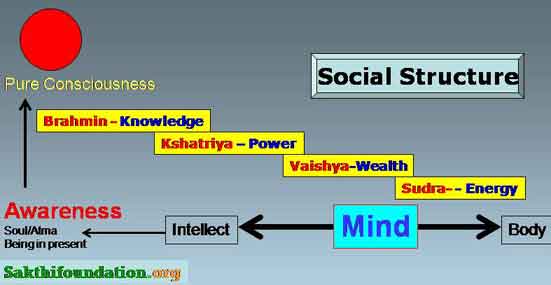 The Caste system is the one of the concept of Vedic Tradition that is highly misunderstood. The above picture shows the four major caste representing four aspects of operation. For example in a digital camera making company, the cause of the formation of the company was the knowledge behind the digital-camera. A scientist who discovered the technology and the Research and Development team is sort of the Brahmin class of the company. The executive officers who "power" runs the company becomes the Kshatriya group. The sales team does the Vaisya job of the company. The production people becomes the Sudra group of the Company.
Here all the four class of group are each vital as the four pillars of the company. This strategy is what is seen is the cosmic order or prapancha purusha:- the cosmic form of divine power or the universe; - and hence given in purusha sooktha. Here brahmana = knowledge, kshatriya = intelligence in structure (management) , vaisya = expression and sudra = frame-work (materialism). It is not concerned with human beings or society or job wise stratification or profession. Let us read the mantra and the meaning.
Brahmano asya mukham aaseeth, baahu raajanya kruthaa, ooru thath asya yad vaisya: padbhyaam sudro ajaayatha, chandrama manasa: jaatha chaksho sooryo ajaayatha, mukhaath idrascha agnischa pranaath vayurajaayatha naabhyaam aseeth yad anthareeksham, seershno dyou sama varthatha, padbhyaam bhoomim disa sthothraath thadaa lokaan akalpayan….
The “shape” of the prapancha purusha/the cosmic form is symbolically composed of the following: Knowledge (awareness and consciousness) became the brain of the cosmic form, protection forces as his hands (kshatriya), the thigh as its vyavahara ( vaisya) and feet as the support (sudra)…(.there the mantra is not ending, it continues)….. the moon (chandrama) became the mind, the sun (soorya) became his eyes, Indra and agni (be)came from the face (mukhath), the vayu (breathing) became the praana (life force), atmosphere (anthareeksham) became its stomach, the celestial bodies (dyou) keep the body in balanced way. Using the feet (padbhyaam), the prapancha purusha kept the directions of earth and thus the universe was composed / guided /made.
Where is the chathurvarnyam/ caste system and all the nonsense which people interpret? This can have another meaning also based on the modern scientific interpretations “ as is the microcosm so is the macrocosm “ says the vedaantha and ultra modern physics. If that meaning is taken then : in the same human body, the head/brain is brahmana, hands are kshatriya, thigh the vaisya and feet the sudra, the mind is moon, the eyes are the sun, the face is agni and indra, the breathing air is praana, belly is the anthariksha ……. and so on. So everything is in the body which is equated with the universe. It has nothing to do with the society or social positions. If it has social component, where we shall put the indra , agni, vayu, sun, moon, atmosphere,…..? (Reference from The Indian Institute of Scientific Heritage).
Though all four groups mentioned in the company are vital, it is unfortunate to see that each group get varying degrees of benefits and honor from the company. Depending upon the hierarchy the group members enjoy the benefits from the company. Over time this also happened in India. The intellectual class over-powered other groups, rottening the whole social system of India.
- Details
- Parent Category: Vedas Sakthi
- Category: Rituals
- Hits: 12914
Camphor
Camphor is a very unique chemical that will vaporize directly from solid to gaseous state even without undergoing the intermediate state of liquid state. Camphor also has a unique smell or
 Vasana. Vasana in Sanskrit and Tamil languages also mean impressions of the mind. In the section Vasana we discussed that the impressions in the mind has to be cleared to attain free from the ever ending cycle of births and deaths.
This is symbolically done in all rituals as the burning of camphor is the fire of knowledge. The fire for extinguishing the vasana is the knowledge about the Self. Unlike burning other materials camphor does not leave any trace of it in the form of ashes. It completely vaporizes and so should be of mental impressions that should be extinguished even without expressing it (liquid form) and leave no trace of it, which means no identity about our Ego.
In almost all Vedic rituals this burning of the camphor is performed as a ritual in the culmination of events and the image of the God is shown when the camphor burns to symbolize that the Self is revealed in the light of extinguishing camphor. Without extinguishing even traces of mental impressions of desires there is always a return to the cycle of death and birth.
See additional discussion about camphor and rebirth.
- Details
- Parent Category: Vedas Sakthi
- Category: Rituals
- Hits: 9291
Incense Sticks
These following questions are discussed here
1. Why do we use lamp (light), incense sticks chanting, rotate rosary beads in rituals?
2. Whys is bell rung in aarathi or Arti?
3. Why do we close eyes in prayer?
As we discussed in the earlier sections that seclusion helps a child to focus in studying his school books by preventing distracting thoughts in the mind. A spiritual place of worship is also meant for the very same environment that would be less distracting for the mind, so that it will be available for transcending.
The rituals or mode of worship should lead the individual to the awareness state. The place or ritual should help in less distraction for the mind. By the way here we do not mean by physical silence. Contrary is true because sounds of bells , prayers, songs, chanting, instrumental music drum beatings etc lead the distracting mind to the state of awareness.
There are five sense organs (Eyes, nose, skin (hands), mouth and ears ) and the mind wanders when these five organs give stimuli to the mind. A temple or a puja room give these five sense organs stimuli that would allow the wandering mind to stay in focus. The bright lamp offers stimuli to the eyes, the smell of fragrant incense sticks to the nose, while the hands rotate rosary beads and mouth keeps chanting the prayers. In spite of these actions the mind wanders , but when the mind hears the most subtlest sense of sound through ringing of the bells, the wandering mind comes back to the present. This is called Arti or aarathi.
The mind will can stay focus only if there is some logic and so these logical work given to the five senses will help them to grab on it and so the mind is free to focus or transcend to the state of awareness. This transcendence is prayer. Prayer is transcending to our own Self which religion calls as God. There is no external God which can exclude this internal Self. Hence while praying we close our eyes to with draw our mind internally. This very act of closing eyes in prayer is a symbolic representation of with drawing mind to the Self.

Subcategories
Festivals
Pilgrimages
Yathra
Yatra
